

Guide: Publish, Process and Versions
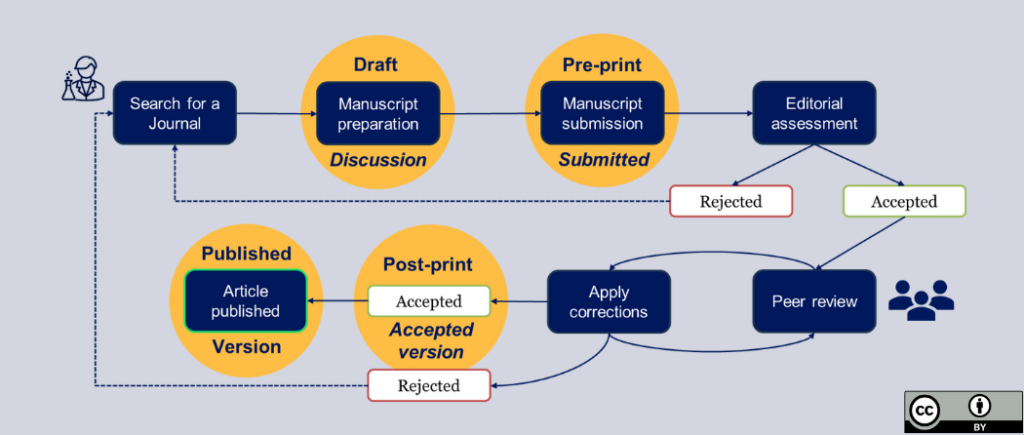
The process of publishing in a peer-reviewed journal can be broken down into several consecutive phases, involving different participants:
- Searching for and finding a scientific journal: Using various databases, you can search for journals based on their subject area and scientific impact. [For more information, see the Find the Best Journal tab].
- Manuscript Preparation: The team works on drafting the first version of the scientific article. It is important to keep in mind the publication guidelines established by publishers regarding style and format, the preparation of citations and references, and ethics and transparency.
- Submitting the Manuscript: Once you have selected the journal where you wish to publish, you should submit the completed manuscript (preprint) through the journal’s online submission system. You will typically need to create a user account.
- Editorial review: The journal evaluates the relevance of the content and whether it aligns with the journal’s scope, and then decides whether or not to accept the submission for publication.
- Peer-review process: If the submission is accepted, the peer-review process begins. Experts in your field review the article’s content, structure, writing, and style. You receive feedback and suggestions to improve your work and ensure its high quality. The review can take several forms:
- Single-blind review: The reviewers know the authors’ identities, but the authors do not know the reviewers’ identities.
- Double-blind review: Neither the authors nor the reviewers know each other’s identities.
- Open review: Both the authors and the reviewers know each other’s identities.
At this stage, reviewers may accept the submission, continue the review process, or reject it for publication.
- Article Publication: Once the article has been proofread, a decision is made regarding which publication method—closed or open—will be used. [For more information, see the Publication Methods tab].
 Biblioteca IQS (2025). Under Creative Commons License CC-BY.
Choosing the scientific journal in which to publish your research is one of the most critical decisions in the academic publishing process. A wise choice greatly increases the visibility, impact, and reach of your work.
What should you keep in mind when choosing a magazine?
You’ll find most of this information on each journal’s official website, specifically in the About this Journal or Submit an Article sections. Keep the following points in mind:
- Subject Matter Coverage: Does the journal’s scope align with the topic of your article?
- Article Types: Check which formats are accepted (original articles, reviews, short notes, etc.).
- Editorial Team: Who are the editors and committee members? Their reputation adds value to the publication.
- Peer Review Process: Learn about the evaluation system they use.
- Publication Timelines: Check the average time from acceptance to publication to see if it aligns with your needs for getting the document published.
- Ethics and Best Practices: Make sure the journal follows international standards, such as the guidelines issued by COPE (Committee on Publication Ethics).
- Guidelines for Authors: Review the specific formatting requirements for text, images, graphics, and citations.
- Open Access Options: Identify the publication route: Gold (fee-based), Diamond (free), Bronze, or Green (self-archiving). Save money! Check to see if the publisher has transformative agreements with IQS to cover the Article Processing Charge (APC).
- Journal Impact: Check the bibliometric indicators, such as the impact factor, quartile, or percentile ranking of the journal within its disciplinary category.
Recommended tools for finding your magazine
Depending on the topic and the acceptance timeframe
Many publishers offer free tools where, by entering the title, abstract, or keywords of your paper, their algorithm suggests the journals that are best suited to your article.
- Elsevier Journal Finder: It displays key data such as the CiteScore (impact), open access options, review times, and publication costs (APC).
- Wiley Journal Finder: It recommends journals from the Wiley catalog based on subject relevance, highlighting their impact, open access options, and ranking positions. It allows you to select multiple journals and compare them using a comparison table.
- Springer Nature Journal Finder: It provides information on the cost of open-access publication, the journal’s impact, and the number of days it takes to respond to a submission.
- Taylor & Francis Journal Suggester: It suggests journals from the Taylor & Francis catalog, providing information on the journal’s impact, acceptance rate, and open access options.
- Emerald – Find a journal: Retrieves journals published by Emerald. Displays the acceptance rate, the number of days required to evaluate an initial acceptance, and the journal’s impact factor. Allows you to compare journals with one another on a single dashboard.
- IEEE Publication Recomender: Suggest journals or conferences in the field of engineering and technology (IEEE). Provide information on impact factor, open access, and event details if it is a conference.
- Master Journal List (Clarivate): It allows you to retrieve journals indexed in Web of Science.
According to Open Access
- DOAJ: open-access journals search tool. It allows users to search by multiple editorial criteria and apply filters based on license type or peer review status, making it ideal for those looking to publish in open access.
Based on impact and indexing
- Journal Citation Reports (JCR): A multidisciplinary reference database (linked to the Web of Science Core Collection). It evaluates the impact of journals using indicators such as the Journal Impact Factor (JIF), quartiles, and percentiles. You can consult Clarivate’s Journal Citation Reports Guide.
- Scimago Journal Report: A public portal that ranks scientific journals indexed in the Scopus database. It provides metrics such as the H-index, the SJR impact factor, and quartiles.
- CiteScore (Scopus): The Sources section of Scopus allows users to search for journals by subject, title, publisher, and ISSN. It displays journal rankings based on CiteScore and quartile.
More information on journals’ impact
Avoiding Predatory Journals (Checklist)
- Think, Check, Submit: A global campaign that offers a practical guide and a list of key questions to help you assess whether a journal is reputable and avoid falling victim to fraudulent or predatory publishers.
Throughout the publication process, as versions are exchanged among the authors, reviewers, and the publisher, the following versions are created:
- Draft / Discussion paper: A draft document that all the authors are working on to write the article.
- Preprint / Submitted Version: Version submitted to the journal.
- Postprint / Accepted Version: The final accepted version, including all corrections and changes made during the peer-review process. Furthermore, if the article is ultimately published in the journal under a closed or restricted access model, this is the version that publishers allow to be deposited in an open-access institutional repository, subject to any embargo periods and rights restrictions.
- Published version: Final version formatted by the journal, including the article’s DOI and copyright information. It can be published as a closed-access or open-access article. [For more information, see the Publication Methods tab].
 Biblioteca IQS (2025). Under Creative Commons License CC-BY.
Gold Open Access – Free Access
Readers can read and download the publication for free. In contrast, the authors of the work must pay the publication cost—article processing charges (APCs)—to the publishers in order to publish openly and retain their copyright under Creative Commons licenses.
Diamond Open Access – Free Access
Readers can read and download the publication for free. At the same time, authors can publish their work as open access at no cost.
Free Access (Bronze) – Free Access
Readers can read and download the publication for free (sometimes on a temporary basis), but the rights to exploit the work are transferred to the publisher and are not retained by the author under Creative Commons licenses.
Green Open Access
A publication originally published in a subscription-based journal or book (closed access) that is deposited in an institutional or general-access open-access repository, under the conditions stipulated by the publisher. Typically, the accepted version (post-print) of the publication may be deposited in open access under a Creative Commons license following a certain embargo period (restricted access) that can range from 6 to 24 months. Example of a Green Open Access article.
You can view the publishers’ terms and conditions on Jisc – Open Policy Finder.
Closed – Access by subscription or payment
There is no cost to researchers for publishing in the journal, but readers must pay for individual access to the article or pay for a subscription to the journal. Typically, the library services at universities or research institutions cover the costs of journal subscriptions.